This post was originally published in December 2021. Last updated: October 2026.
Drywall is cheap and familiar, but it is not the only way to finish a wall. In a basement, garage, or any space that sees moisture, it is often the wrong one. The main drywall alternatives are water-resistant wall panels, FRP, plywood or OSB, metal panels, fiber cement board, and wood plank or shiplap, and each one trades off differently on moisture resistance, durability, and how hard it is to install yourself. Some hold up fine in a dry room and fail the moment they see real humidity. Below, we compare ten options side by side, then narrow in on which ones actually make sense in a basement.
That’s why so many homeowners look for drywall alternatives for basement walls. This guide covers why basement drywall struggles, how the common alternatives compare, and where water-resistant wall panels fit in.
Drywall Alternatives at a Glance
The comparison below lines up ten common drywall alternatives on moisture resistance, DIY difficulty, and where each one works best, so you can narrow the field before reading the basement-specific breakdown further down.
| Material | Moisture resistance | DIY difficulty | Best for |
|---|---|---|---|
| Trusscore Wall&CeilingBoard | Excellent | Easy | Basements, garages, and other moisture-prone or high-traffic spaces |
| FRP | Excellent | Moderate (adhesive and trim) | Commercial kitchens, bathrooms, and workshop walls |
| Plywood or OSB | Moderate (needs sealing) | Easy | Dry, climate-controlled rooms and workbench walls |
| Metal panels | High (watch for condensation behind panels) | Moderate | Industrial-look spaces and high-impact areas |
| Fiber cement board | High | Difficult (specialized cutting tools) | Wet zones that need a tile backer or heavy-duty surface |
| Wood plank | Poor (needs sealing) | Moderate | Dry, finished living spaces where look matters most |
| Shiplap | Poor (needs sealing) | Moderate | Feature walls in dry dens, bedrooms, and living rooms |
| Beadboard | Poor (needs sealing) | Easy | Wainscoting, hallways, and other dry living areas |
| Cork | Fair (needs sealing) | Moderate | Home offices, dens, and dry feature walls |
| Textured wall panels | Fair (varies by material) | Easy | Accent walls in dry living spaces |
Is a Drywall Alternative Worth It?
Drywall almost always wins on sticker price. It’s the cheapest material to buy, and most contractors already know how to hang it. The cost that doesn’t show up on day one is what happens after: taping, mudding, sanding, and painting before the wall is even finished, then repairs, repainting, and possibly full replacement if moisture ever gets behind it.
A drywall alternative usually costs more upfront, sometimes significantly more, but that gap narrows or closes once you count what drywall needs over the life of the wall. A water-resistant panel that never needs repainting, never needs patching, and survives a flood instead of failing in it can cost less to own over ten years even if it costs more to buy today. The math changes with the room: a dry, low-traffic space may never justify the premium, while a basement, garage, or bathroom usually does. If you’re weighing a different room, see our guide to drywall alternatives for garage walls, or check ceiling alternatives to drywall if you’re finishing overhead too.
Decorative Drywall Alternatives for Dry Rooms
Not every drywall alternative is built for water. If you’re finishing a dry living space, a den, or a feature wall, there are good-looking options beyond a painted sheet of gypsum: shiplap, beadboard, wood paneling, cork, and textured wall panels. They share one weakness. Most are wood or wood-based, so they swell and warp when humidity or water is part of the picture. That’s why the right alternative depends less on style than on the room. Here’s how the decorative options compare, and where each one stops being a good idea.
Shiplap
Shiplap gives a wall clean horizontal lines and a farmhouse or coastal look, which suits living rooms, bedrooms, and feature walls. Boards are typically wood or a wood composite, and both take on moisture at the joints. Seal and paint every face, including the back and edges, and keep it out of rooms with real humidity.
Verdict: Fine with sealing
Beadboard
Beadboard adds vertical grooves and a classic cottage look, either as full-height paneling or as wainscoting in hallways, dens, and bedrooms. It comes as sheets or planks, usually wood or a wood composite, so a worn paint coat leaves the material exposed. Keep the finish intact and keep it away from direct water.
Verdict: Fine with sealing
Wood paneling
Wood paneling brings warmth and texture to dens, offices, and bedrooms. Real wood and wood veneer both react to humidity: they swell, warp, and can rot where water sits. It’s a good choice for a room with steady, low humidity and a poor one for anywhere that sees spills, steam, or seepage.
Verdict: Dry rooms only
Cork
Cork gives a wall a soft, natural texture and an earthy look, which suits home offices, dens, and reading nooks. It’s a natural bark product, but seams and adhesive can lift when a wall stays damp. Seal the surface and the seams, and skip it in any room that sees standing water.
Verdict: Fine with sealing
Textured and 3D panels
Textured and 3D wall panels add depth and shadow to a feature wall, so they suit living rooms, bedrooms, and entertainment areas. Panels are made from materials such as medium-density fiberboard, gypsum, and plant fiber, and what’s inside decides how much moisture a panel can take. Check what a panel is made of before you buy, and treat any wood-based or paper-faced panel the way you’d treat drywall around water.
Verdict: Dry rooms only
Why Drywall Fails in a Basement
Moisture performance matters more in a basement than almost anywhere else. Above grade, drywall stays mostly dry; below grade, it faces year-round humidity plus water events from minor seepage to a flooded floor. Drywall, sometimes sold as Sheetrock, reacts the same way regardless of brand, so if you’re weighing sheetrock alternatives, the moisture problem is the one you’re really solving.
How moisture damages drywall
Drywall doesn’t work well in a basement because its gypsum core absorbs water. A drywall sheet is gypsum sandwiched between two paper layers, and when it gets wet, the gypsum softens, turns crumbly, and loses its strength. The surface stains, bubbles, and sags. Once drywall is soaked, the fix is usually to cut it out and replace it, which means taping, mudding, sanding, and repainting again. And if the underlying moisture problem isn’t solved, the new drywall can fail the same way.
The mold risk drywall creates
Damp drywall can also become a surface for mold. The paper facing is made from cellulose, which is a food source for mold. Add the warm, dark, humid conditions common in basements, and once drywall stays wet, mold can take hold within 24 to 48 hours of water exposure. This doesn’t mean every basement with drywall grows mold. A well-sealed, consistently dry basement often does fine. But where moisture keeps coming back, drywall gives mold both the conditions and the food it needs, and cleanup usually means tearing out the affected material.
Other Basement Wall Options (and Why They Fall Short)
Drywall isn’t the only way to finish a basement, and it isn’t automatically the wrong one either. Several alternatives to drywall in a basement handle moisture better, though each has trade-offs in cost, durability, installation, or appearance. The right basement wall material depends on how much moisture your space sees and how you’ll use the room. Here’s how the most common options stack up.
Moisture-resistant drywall
Moisture-resistant drywall, sometimes called green board, holds up better than the standard product in damp areas. A treated core and a coated facing slow moisture absorption, which makes it a reasonable step up for a bathroom or a basement with mild humidity. What it isn’t is water-resistant. The core is still gypsum, so standing water, flooding, or long-term dampness can still ruin it. Treat it as more forgiving than standard drywall, not as something that shrugs off water.
Cement board
Cement board is a dense, rigid panel of cement and reinforcing fibers. It won’t dissolve or grow mold when wet, so it’s far more moisture-tolerant than any gypsum product, and it’s often used as a tile backer in showers. The trade-offs are weight, labor, and finish: it’s heavy, slower to hang, and on its own it’s an unfinished gray surface that still needs tile or another covering to look complete. Across a whole basement that adds up fast, so cement board makes the most sense in specific wet zones rather than every wall.
Plywood and wood paneling
Plywood and wood paneling give a basement a warm, finished look and install quickly over standard framing. Plywood holds fasteners well and makes a solid backing for shelving. The catch is that wood and moisture don’t mix. Even treated or exterior-grade plywood can swell, warp, and rot with repeated dampness. In a dry, well-managed basement, wood can be a good-looking choice. In one that floods or stays humid, it carries much the same risk as drywall.
The table below lines up the main basement wall materials on the factors that matter most below grade. Use it as a quick reference, then read on for where water-resistant panels change the equation.
| Material | Moisture resistance | Durability | Maintenance | Installation | Key limitation |
|---|---|---|---|---|---|
| Standard drywall | Poor | Low | High | Taping, mudding, sanding, painting | Absorbs water and can grow mold |
| Moisture-resistant drywall | Fair | Low to moderate | Moderate | Same finishing steps as drywall | Gypsum core still fails under standing water |
| Cement board | Good | High | Low | Heavy, needs tile or a finish coat | Unfinished surface, labor-intensive |
| Plywood and wood paneling | Fair | Moderate | Moderate | Fast over framing | Swells, warps, and rots when wet |
| Trusscore Wall&CeilingBoard | Excellent | High | Very low | Interlocking panels, no finishing | Higher upfront material cost than drywall |
The Water-Resistant Alternative: Trusscore Wall&CeilingBoard
The materials above all manage moisture by resisting it to some degree. A non-porous panel made from rigid PVC takes a different approach: it doesn’t absorb water at all. In a basement, the real question is whether a wall can survive an actual flood and stay usable afterward. Trusscore Wall&CeilingBoard is an interlocking interior wall and ceiling panel made from rigid PVC, engineered to replace drywall in wet, high-traffic spaces, which makes it a natural fit for basement walls and ceilings.
Why water-resistant panels outperform drywall in wet spaces
There’s no gypsum and no cellulose in a Trusscore Wall&CeilingBoard panel, so there’s nothing for water to soak into and nothing for mold to feed on. Water rolls off the surface, and the tongue-and-groove interlock forms a water-resistant barrier. The panels are 100% water-resistant for their entire service life and will never grow mold or mildew. If a basement floods, stained panels wipe clean with soap and water instead of heading to the curb. The benefits that matter most in a basement:
- Water-resistant and non-porous: panels shed water instead of absorbing it, so humidity and flooding don’t degrade them
- Mold- and mildew-resistant: no organic material for mold to feed on, so it can’t establish on the surface
- Durable: half-inch panels that resist scratches, dents, and impacts in a space that often doubles as storage or a workshop
- Low maintenance: a wipe-down is usually all it takes, with no repainting or patching later
- Pre-finished: panels arrive in a bright white or gray finish, so there’s no mudding, taping, sanding, or painting
The bright white finish is a bonus below grade, where it reflects up to 90% of the light that hits it and helps a dim, windowless basement feel brighter without adding fixtures.


Installation speed and DIY-friendliness
Trusscore Wall&CeilingBoard is built for a straightforward install, a big part of its appeal for do-it-yourselfers finishing basement walls without drywall. Panels are 16 inches wide to match standard framing, interlock with a tongue-and-groove system that hides fasteners, and attach directly to bare studs or over existing drywall. Because they arrive pre-finished, the finishing stage of a drywall job disappears: no taping, no mud, no sanding, no priming, no paint. That’s why they install up to four times faster than drywall, and at roughly 40% lighter, one person can usually handle them. The same panels finish ceilings too, so it’s worth comparing your basement ceiling options as you plan the walls.
Building a Fully Organized Basement
Finishing basement walls is also a chance to fix a problem most basements share, which is storage. Plenty of basements double as the household catch-all for laundry supplies, seasonal gear, tools, and bulk goods. If you’re already putting up new walls, it’s worth planning how they can work for you, which pairs with other basement wall ideas you might be weighing.
Pairing Trusscore Wall&CeilingBoard with Trusscore SlatWall
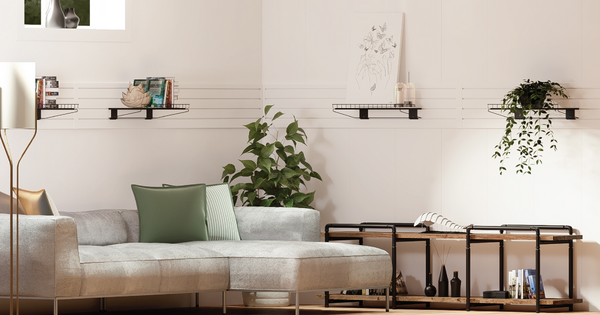
Trusscore® SlatWall™ is a heavy-duty organization panel that installs right alongside Trusscore Wall&CeilingBoard as part of the same system. You finish most of the room in Trusscore Wall&CeilingBoard, then run Trusscore SlatWall wherever you want hanging storage, and the two share the same finish, thickness, and installation method. That kind of direct integration is unusual among slatwall systems, which typically mount as a separate product. Trusscore SlatWall accepts standard hooks, baskets, and shelves that reposition without tools, and it supports up to 75 pounds per square foot, enough for tools, bikes, and heavy bins. In a laundry area, workshop, or utility zone, that turns a plain wall into working storage on the same water-resistant, wipe-clean surface.
What to Know Before You Start
Before committing to any basement wall system, sort out a few practical items. Basement finishing involves more code and moisture considerations than a project upstairs, and handling them up front saves rework later.
Local building code requirements
Requirements vary by location and project, so treat the points below as general considerations, not universal rules. Depending on your jurisdiction and how you’ll use the space, your project may involve several of these:
- Fire ratings: some assemblies, like the wall between a basement and an attached garage, must meet specific fire-resistance requirements
- Insulation: below-grade walls often carry insulation and moisture-barrier requirements tied to your climate zone
- Egress: a finished basement bedroom typically needs a code-compliant egress window or exit
- Electrical work: adding outlets, lighting, or circuits usually calls for permits and inspection
- Structural considerations: framing, support, and changes near load-bearing elements may need review
- Permits: many basement finishing projects require one or more permits before work begins
Worth knowing: Trusscore Wall&CeilingBoard is an interior cladding that installs over a code-compliant wall assembly, not a substitute for fire-rated assemblies, insulation, or a moisture barrier for basement walls. It carries a Class A fire rating, but where code requires a fire-rated wall, the panels go on top of that assembly. Confirm the specifics with your local building department before you start.
Which Drywall Alternative Is Right for Which Room?
The best drywall alternative is the one that matches the room’s worst day. A basement has to survive a flood. A garage has to survive impact, temperature swings, and the occasional hose. A living room has to look good. No single material wins all three, so here’s how we’d choose by room:
- Basement: Trusscore Wall&CeilingBoard or cement board, with more in basement wall ideas and basement walls and ceilings
- Garage: Trusscore Wall&CeilingBoard, FRP, or plywood, with more in drywall alternatives for garage walls
- Ceilings: Trusscore Wall&CeilingBoard, with more in ceiling alternatives to drywall
- Bathroom, laundry, and kitchen: Trusscore Wall&CeilingBoard or FRP
- Living areas and dry rooms: shiplap, beadboard, or painted drywall (painted drywall is fine here)
- Workshop: plywood, FRP, or Trusscore Wall&CeilingBoard, with Trusscore SlatWall for hanging tool storage
Want a head-to-head look at the two materials? Read Wall&CeilingBoard vs drywall for a direct comparison.
FAQ
Is drywall OK to use in a basement?
It can be, but it’s a gamble in most basements. Standard drywall performs fine in a basement that stays consistently dry and well-sealed, with good drainage and humidity control. The problem is that many basements don’t stay dry, and drywall has little tolerance for seepage or flooding. If there’s any real chance of water, a water-resistant material is the safer long-term choice.
What can I use instead of drywall in a basement?
The main alternatives are moisture-resistant drywall, cement board, treated plywood or wood paneling, and water-resistant wall panels. Moisture-resistant drywall and wood options improve on standard drywall but still aren’t water-resistant, and cement board handles water well but needs tile or another finish over it. Water-resistant basement wall panels like Trusscore Wall&CeilingBoard are fully water-resistant, arrive pre-finished, and tend to be the most forgiving in a space that might get wet.
How much does it cost to finish a basement without drywall?
It depends on the material, the size of the basement, whether you hire out labor, and how much prep the space needs. Rather than a single number, weigh upfront material cost against long-term ownership cost. Drywall is cheap to buy but adds finishing labor and can mean expensive repairs when moisture damages it. A water-resistant panel costs more per square foot upfront but skips the finishing steps and holds up without repainting or replacement, which is where much of drywall’s long-term cost hides. For an accurate figure, price your materials with a local retailer, since pricing varies by region.
Do basement walls need to be fire-rated by code?
Sometimes, depending on your jurisdiction and the wall in question. Certain assemblies, most often the wall separating living space from an attached garage, must be fire-rated, while many interior basement partitions are not. Because requirements vary by location and project, confirm what applies with your local building department before you finish. Trusscore Wall&CeilingBoard has a Class A fire rating and installs over a code-compliant, fire-rated assembly wherever one is required.
What is the cheapest alternative to drywall?
The answer depends on what you count. Judge each option on total cost: material, labor, finishing, and replacement if moisture ever gets to it. In a damp room, a water-resistant panel that skips finishing and never needs repainting can cost less to own than a cheaper material that fails.
Can you use plywood instead of drywall?
Yes, in dry rooms. Plywood needs sealing on every face and edge, and it can still warp when humidity swings or water reaches it. Check the comparison table near the top of this page to see how it stacks up against the other options.
Choosing a basement wall material comes down to a few factors: how much moisture the space sees, how durable and low-maintenance you need the finish to be, how much work the install takes, and what your local code requires. Drywall can clear that bar in a dry, tightly sealed basement, but it has little margin for the water below-grade rooms so often get. The good news is that drywall alternatives for basement walls have come a long way, and water-resistant wall panels in particular let you finish a space that shrugs off humidity and flooding instead of falling to it. If Trusscore Wall&CeilingBoard sounds like the right fit, order samples to see the finish in person or find a retailer near you to price out your project.