This post was originally published in December 2022. Last updated: May 2026.
Most garages have one thing in common: a ceiling that’s easy to ignore. Exposed joists, bare insulation batts, or a forgotten layer of drywall from a decade ago—none of it is doing much for the space. But the ceiling has more influence on a garage than most people realize. It affects how bright the space feels, how well it handles moisture and temperature swings, how easy the room is to maintain, and whether the garage actually feels finished or just tolerated.
Before you pick a material, there are five factors worth thinking through: moisture resistance, upfront cost, DIY friendliness, insulation compatibility, and long-term maintenance. This article covers all five in the context of the materials that make the most sense for a garage—drywall, Trusscore® Wall&CeilingBoard™, plywood and OSB, metal panels, and drop ceilings.
What to Consider Before Choosing a Garage Ceiling
Garage ceilings face conditions that most interior living spaces never see. Temperature swings of 50°F or more between seasons, humidity from wet cars and tools, exhaust, oil mist, and the occasional impact from a misplaced ladder—these environments are hard on materials that weren’t designed for them. Before comparing options, it’s worth understanding the factors that will determine how well a ceiling actually holds up.
Moisture and temperature resistance
Garages without HVAC experience wide temperature swings that cause condensation to form on cold surfaces. In humid climates, moisture can accumulate year-round. Materials like standard drywall are particularly vulnerable: they absorb moisture, grow mold, and gradually deteriorate in uncontrolled environments. Choosing a material that’s built for moisture exposure—or at least treated to resist it—is one of the most important decisions in a garage ceiling project.
Budget and material cost
Material cost is only part of the picture. Labor, finishing steps, and long-term maintenance all affect the true cost of a garage ceiling. A material that’s cheap to buy but requires mudding, sanding, painting, and periodic repainting may cost more over time than a higher-priced option that installs quickly and needs almost no upkeep. Factor in the full lifecycle cost, not just the price per square foot at the lumber yard.
DIY vs. professional installation
Some garage ceiling materials are genuinely DIY-friendly: they’re lightweight, forgiving, and don’t require finishing trades. Others involve taping, mudding, sanding, and painting—work that’s manageable for experienced DIYers but adds time and complexity for most homeowners. If you’re hiring out the labor, material weight and installation speed directly affect what you’ll pay.
Insulation compatibility
If you plan to heat or cool your garage—or simply want to reduce temperature extremes—insulation compatibility matters. Most ceiling materials install over existing batt insulation without issue. Rigid foam insulation can also work, though it changes the installation approach depending on the material and framing. Drop ceilings are particularly insulation-friendly: they allow you to lay insulation on top of the grid panels without any additional framing. Some panel systems also allow future access to the cavity above if you want to add or upgrade insulation down the road.
5 Best Garage Ceiling Materials Compared
The best garage ceiling material depends on your budget, how you use the space, your local climate, and how much finishing work you’re willing to take on. Here’s a quick comparison of the five most practical options before diving into the detail of each.
| Material | Installed Cost | DIY Difficulty | Moisture Resistance | Maintenance | Insulation Compatibility |
|---|---|---|---|---|---|
| Drywall | ~$2 to $3/sq ft | Moderate | Low | High | Good |
| Trusscore Wall&CeilingBoard | ~$3 to $4/sq ft | Easy | Excellent | Very low | Good |
| Plywood/OSB | ~$1 to $2/sq ft | Easy | Moderate | Moderate | Good |
| Metal panels | ~$3 to $6/sq ft | Moderate | Good | Low | Fair |
| Drop ceiling | ~$2 to $5/sq ft | Easy to Moderate | Moderate | Moderate | Excellent |
Drywall
Drywall is the default choice for most residential ceilings, and it works in garages—with some important caveats. It’s widely available, relatively inexpensive at roughly $2 to $3 per square foot installed, and produces a smooth, paint-ready surface. For attached garages with good airflow and climate control, it’s a reasonable option.
The problem is that garages are hard on drywall. Without HVAC, temperature swings cause expansion and contraction that leads to cracking over time. Moisture—from condensation, wet vehicles, or high humidity—causes drywall to stain, sag, bubble, and mold. And the installation process is labor-intensive: cutting, fastening, taping, mudding, sanding, and painting adds up quickly, both in time and cost.
Moisture-resistant drywall (often called green board) performs better in damp environments, but it’s still a paper-faced product and not truly waterproof. For unheated garages or climates with high humidity, there are better options.
Trusscore Wall&CeilingBoard
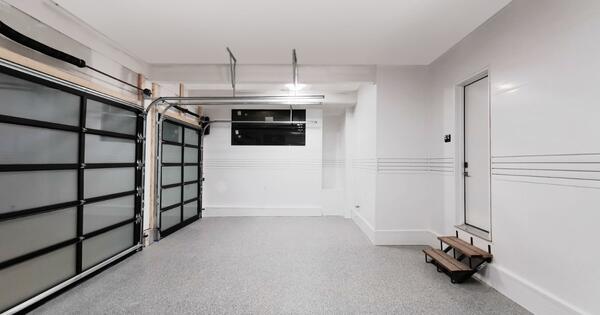
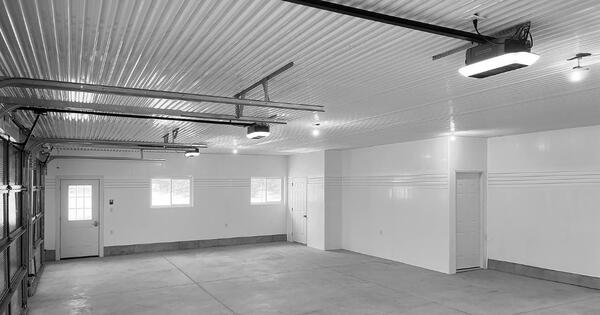
Trusscore Wall&CeilingBoard is a high-performance, PVC-based panel that’s engineered for durability, ease of maintenance, and moisture resistance, making it a great fit for garages.
For most finished garages, Trusscore Wall&CeilingBoard is the strongest all-around option. These interlocking PVC panels are 100% water and moisture resistant throughout their entire service life—not just water-resistant in the short term, but genuinely waterproof by material composition. There’s no paper facing, no gypsum core, and no organic content for mold to grow on.
Installation is significantly faster than drywall. The tongue-and-groove interlocking system hides fasteners as you go, and the panels arrive fully finished: no taping, no mudding, no sanding, and no painting required. Once they’re up, the job is done. For a complete look at how the product compares to traditional materials, the Trusscore garage and workshop application page is a good starting point.
White Trusscore Wall&CeilingBoard panels have a light reflectivity value of 0.90, meaning they reflect 90% of ambient light. That’s a meaningful difference in a garage where a single LED shop light might otherwise struggle to reach the corners. The panels are also significantly lighter than drywall—about 40% lighter—which makes ceiling installation easier to manage, especially when working alone or overhead.
The panels carry a Class A fire rating (ASTM E84/ULC S102) and are designed to install over standard stud or joist framing on top of existing insulation. They should be installed over a fire-rated wall or ceiling assembly where one is required by code, and they’re not intended to serve as a thermal or vapor barrier on their own.
For a direct comparison against drywall, our drywall ceiling alternative page breaks down the tradeoffs in detail.


Plywood and OSB
Plywood and OSB are the budget workhorses of garage ceiling finishing. At roughly $1 to $2 per square foot installed, they’re among the most affordable options available. Both are strong enough to handle impacts, hold fasteners well, and give you a paintable surface that’s significantly more durable than drywall in a rough environment.
The main limitation is moisture. Neither plywood nor OSB is waterproof. OSB is especially vulnerable—if it gets wet and stays wet, it swells, delaminates, and degrades. Plywood handles moisture better, particularly exterior-grade (CDX) varieties, but it still needs to be sealed or painted to perform well in a garage environment. Both materials also require finishing if you want a clean look: painting at minimum, sanding if you want a smooth result.
For a utility garage or workshop where cost is the priority and you don’t mind periodic maintenance, plywood is a solid choice. OSB works in dry climates for basic applications but isn’t the right call where humidity is a regular concern.
Corrugated and steel metal panels
Metal ceiling panels bring a distinctive industrial look that suits workshops, detached garages, and commercial-adjacent spaces well. They’re extremely durable—resistant to impact, fire, and pests—and require very little maintenance once installed. Installed cost typically runs $3 to $6 per square foot depending on the panel type, profile, and whether you hire the work out.
There are real tradeoffs to consider. Metal conducts temperature quickly, which means it can amplify condensation in uninsulated garages—the opposite of what you want in a humid climate. Metal ceilings also amplify rain noise and impact sounds more than other materials. And the industrial aesthetic, while appealing in the right context, doesn’t work for everyone.
Where metal panels shine is in unheated utility garages and workshops where extreme durability and fire resistance are the top priorities, or where the visual aesthetic fits the overall design intent.
Drop or suspended ceilings
Drop ceilings—also called suspended ceilings—consist of a metal grid hung from the structural ceiling, with acoustic tiles or panels set into the grid. They’re a common choice in finished basements and commercial spaces, and they make sense in certain garage applications too. Installed cost typically runs $2 to $5 per square foot depending on tile quality and labor.
The biggest advantage of a drop ceiling is access. If your garage has utilities above—HVAC ducts, plumbing, electrical runs—a suspended ceiling lets you reach them by lifting a tile rather than cutting into drywall. That matters both for initial installation and for future maintenance.
The tradeoff is headroom. A suspended grid typically drops the ceiling by 4 to 6 inches, which can feel significant in a standard 8-foot garage. In garages with taller ceilings or where vehicle clearance isn’t an issue, the headroom loss is less of a concern. Tile quality varies widely—basic acoustic tiles aren’t particularly moisture-resistant, but moisture-resistant tile options are available for garages with humidity concerns.

Lighting Ideas to Brighten Your Garage Ceiling
Lighting and ceiling material work together more than most people expect. A reflective ceiling surface distributes light more evenly across the space, reduces shadows, and makes a garage feel significantly larger and brighter without requiring additional fixtures. The material you choose for your ceiling directly affects how much work your lighting system has to do.
LED strip and panel lighting
LED shop lights and panel fixtures are the most popular choice for garage ceilings, and for good reason. They’re energy-efficient, produce excellent color rendering, and are available in a range of color temperatures—from warm white for a comfortable workshop feel to cool daylight for tasks requiring accurate color. LED strips can be run along joists or panel seams for continuous ambient light, or mounted as discrete fixtures. Pair them with a bright white ceiling surface and the difference in light distribution is substantial.
Recessed lighting
Recessed can lights are a clean option for finished garages where aesthetics matter. They sit flush with the ceiling surface, avoid protruding hardware, and spread light evenly when placed at consistent intervals. They work particularly well with drywall and PVC panel ceilings where a smooth, flat surface is already in place. The main consideration is ensuring the junction boxes are rated for the ceiling insulation value above them.
Fluorescent and shop light fixtures
Fluorescent tube fixtures and their LED replacements remain a practical, cost-effective choice for garages. They’re wide, they cover a lot of area with a single fixture, and surface-mount installation is straightforward. The combination of a white reflective ceiling—particularly one with a light reflectivity value near 0.90, as Trusscore Wall&CeilingBoard achieves—and evenly spaced shop lights can make a single-car garage feel as bright as a commercial workspace.
Ceiling Colors and Finishes That Maximize Brightness
Color and surface finish have a measurable effect on how bright a garage feels. Dark or matte surfaces absorb light; light-colored, gloss or semi-gloss surfaces reflect it. For garages where brightness matters—workshops, hobby spaces, or any garage used for detailed work—this difference is real and worth planning for.
White is the standard recommendation, and it’s standard for good reason. A bright white ceiling reflects light back into the space rather than absorbing it, reducing the number of fixtures you need and making the overall environment more pleasant to work in. Off-whites and very light grays can work, but they’ll always reflect less than pure white.
Gloss and semi-gloss finishes further improve reflectivity over flat or matte paint. If you’re painting drywall or plywood, choosing a semi-gloss white rather than a flat finish is an easy upgrade that costs nothing extra. Trusscore Wall&CeilingBoard panels arrive with a white semi-gloss finish already applied—no paint required—and their 0.90 light reflectivity value is among the highest available for a garage ceiling material.

Smart Ceiling Storage Solutions
Finishing the ceiling opens up the opportunity to use it. Ceiling-mounted and wall-mounted storage systems can dramatically increase the usable capacity of a garage without taking up floor space—but they work best when planned alongside the ceiling material selection rather than as an afterthought. A well-organized garage is both a ceiling and a wall project.
Overhead racks for seasonal and bulk storage
Ceiling-mounted overhead racks are the most efficient way to store items you use infrequently. Anchored to ceiling joists, they can hold seasonal items like holiday decorations and camping gear, bulk storage like paper products and bottled water, and long-term items that don’t need regular access. The key is making sure the racks are secured to structural framing—ceiling drywall or panels alone won’t support the load.
Trusscore SlatWall for wall-mounted organization
Ceiling organization and wall organization work best as a system. Trusscore SlatWall integrates seamlessly with Trusscore Wall&CeilingBoard, allowing you to combine clean finished wall panels with a built-in organization track in the same wall run. SlatWall accepts a wide range of hooks, bins, and brackets, turning dead wall space into fully functional storage without requiring separate mounting hardware or pegboard.
If you’re planning a full garage finish, thinking through wall and ceiling together—rather than treating them as separate projects—produces a better result. For practical inspiration on layout and storage planning, our garage organization guide covers a range of approaches for different garage types and uses.
Pulley systems for bikes, kayaks, and heavy gear
Pulley and hoist systems are a practical solution for storing large, heavy items—bikes, kayaks, canoes, ladders, and seasonal lawn equipment—overhead without taking up floor space. A ceiling-mounted hoist lets you raise the item for storage and lower it when you need it, and modern systems are designed to be operated by a single person. Like overhead racks, these must be anchored into structural framing rather than ceiling surface material.
The right garage ceiling depends on how you use the space. If budget is the driving factor and moisture isn’t a concern, plywood gets the job done at the lowest cost. If you want a ceiling that handles moisture, requires minimal maintenance, installs faster than drywall, and makes the garage significantly brighter, Trusscore Wall&CeilingBoard is the strongest option for most finished garages. The combination of 100% moisture resistance, a 0.90 light reflectivity value, Class A fire rating, and a tongue-and-groove system that requires no finishing makes it the most practical low-maintenance ceiling material available.
For garages with utilities overhead, a drop ceiling is worth serious consideration for the access it provides. For utility spaces where durability and industrial aesthetics are the goal, metal panels hold up well. And for homeowners working with a tight budget in a dry climate, plywood remains a reliable starting point that’s easy to upgrade later.
Whatever direction you go, finishing the ceiling is one of the highest-impact upgrades you can make to a garage
FAQ
What is the cheapest way to finish a garage ceiling?
The cheapest way to finish a garage ceiling is with plywood or OSB, which typically runs $1–$2 per square foot installed. Both are easy to cut and fasten, require no specialized trades, and provide a workable surface for paint or organization hardware. The tradeoff is that neither is moisture-resistant without sealing or treatment, and OSB in particular doesn’t hold up well if the garage experiences regular humidity. For a tight budget in a dry climate, plywood is the better of the two.
Drywall is a similar cost but adds labor for taping, mudding, and finishing, which often pushes the total higher than plywood once all steps are included. If you’re doing the work yourself and want the lowest overall cost, plywood is typically the most practical starting point.
Do I need to insulate my garage ceiling?
Insulation isn’t required, but it’s worth adding if you use the garage in cold weather, want to reduce temperature extremes, or are finishing the space as a workshop or hobby area. Batt insulation installed between ceiling joists before paneling is the most common approach and is compatible with virtually all ceiling materials. Drop ceilings offer a particularly easy path to insulation—batts can be laid directly on top of the tile grid without any additional framing or modification.
If you’re in a climate with cold winters, an uninsulated garage ceiling can account for significant heat loss, especially in attached garages where the ceiling borders conditioned space above.
Can you put a drop ceiling in a garage?
Yes—drop ceilings work well in garages, particularly those with utilities running above the ceiling line. The suspended grid allows you to access ductwork, wiring, and plumbing by simply lifting a tile, which makes future maintenance significantly easier. The main limitation is headroom: a standard drop ceiling installation reduces ceiling height by 4 to 6 inches, so it’s better suited to garages with 9-foot or taller ceilings. In a standard 8-foot garage, the headroom loss may feel uncomfortable, especially if you’re working with tall vehicles or equipment.
Is drywall a good choice for a garage ceiling?
Drywall works in attached, climate-controlled garages where humidity and temperature are managed. In those conditions, it’s affordable and produces a clean result. The problem is that most garages don’t stay dry. Without HVAC, temperature swings cause condensation, which drywall absorbs and holds. Over time, that leads to staining, sagging, mold growth, and eventual replacement. Drywall also requires more labor to install than other options—taping, mudding, sanding, and painting add time and cost that often make it a more expensive option than it appears at the outset.
For an unheated or uninsulated garage, or any space with regular moisture exposure, PVC panels or plywood are more practical long-term choices.