Most sheds start bare—exposed studs, rough framing, and whatever the light can reach from the doorway. It gets the job done, but barely. Finishing your shed's interior walls changes everything: how it looks, how it functions, and how long it lasts. The tricky part is choosing the right material for the job.
This guide breaks down the best shed wall panels on the market, compares your options honestly, and gives you a clear path from bare studs to a finished space you'll actually enjoy using.


Why Finish Your Shed's Interior Walls?
Finishing your shed's interior isn't just about aesthetics. The right shed wall covering protects your investment, improves how you use the space, and makes your shed more comfortable to work in year-round.
Protection from Moisture, Pests, and Damage
Exposed framing gives moisture, insects, and rodents an easy way in. A finished wall creates a barrier that reduces the risk of rot, mold, and pest intrusion. In climates with temperature swings—hot summers and cold winters—a finished interior also makes it easier to add or improve insulation, which helps regulate temperature and prevent condensation that can damage stored items.
Better Organization and Usable Wall Space
Bare studs offer nowhere to hang tools, mount shelving, or install storage systems. A finished wall gives you a solid surface to work with.
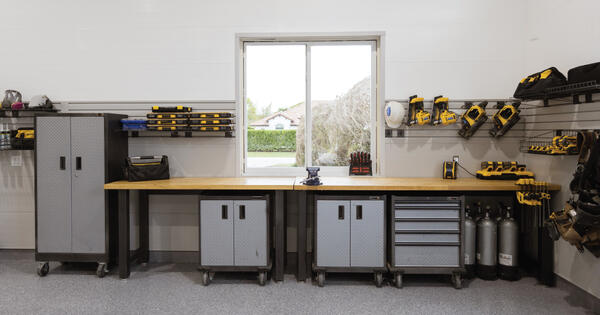
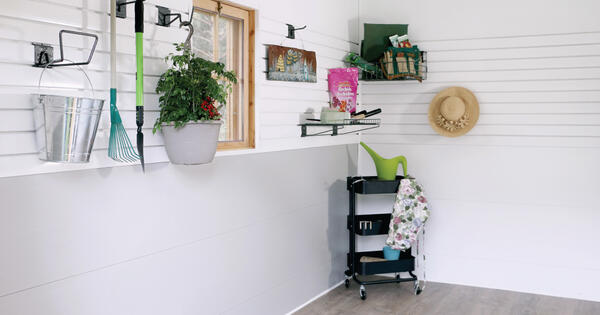
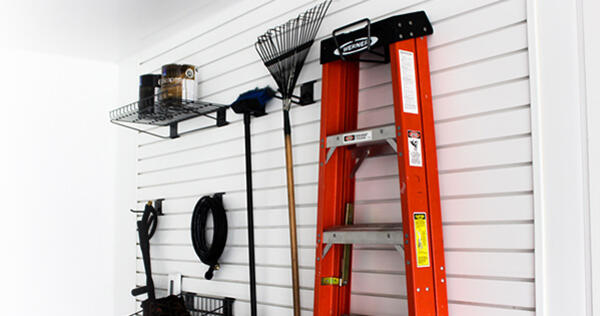
Panel systems designed for garages and sheds—like Trusscore SlatWall—attach directly to finished walls, turning dead wall space into organized, functional storage. Whether you're hanging bikes, storing seasonal gear, or organizing a full workshop's worth of tools, a finished wall makes it possible.
Improved Lighting and Appearance
Dark, unfinished interiors absorb light and make sheds feel cramped. A finished wall—especially a bright white or light-colored panel—reflects light throughout the space, reducing the need for additional lighting and making the space feel significantly larger. For she sheds, home offices, or hobby spaces, a finished interior also sets the right tone for how you'll use the room.
Shed Wall Panel Materials Compared
Not all shed wall materials are created equal. The right choice depends on your shed's purpose, your local climate, and your budget. Here's a breakdown of the most common options.
Material Comparison at a Glance
| Material | Moisture Resistance | Durability | Maintenance | Est. Cost |
|---|---|---|---|---|
| OSB | Moderate | Low to Moderate | Low | $0.50 to $1.00/sq ft |
| Plywood | Moderate to Good | Moderate | Low | $1.00 to $2.00/sq ft |
| Drywall | Low | Low | High | $0.50 to $1.50/sq ft |
| PVC Panels | Excellent | Excellent | Very Low | $2.25 to $3.25/sq ft |
| Beadboard/Shiplap | Good | Moderate | Moderate | $1.50 to $3.50/sq ft |
| Engineered Wood | Good | Good | Low to Moderate | $1.50 to $3.00/sq ft |
OSB (Oriented Strand Board)
OSB is the budget-friendly workhorse of shed wall material. It's widely available, easy to cut, and installs quickly over standard stud framing. For basic storage sheds where cost is the primary concern, OSB does its job. That said, it's not moisture-resistant—if water gets in, OSB will swell, warp, and degrade. It also doesn't take paint as cleanly as plywood, and its rough surface limits what you can hang on it without additional hardware.
Best for: Low-budget storage sheds in dry climates where appearance and moisture resistance aren't priorities.
Plywood
Plywood is a step up from OSB in almost every way. It's stronger, holds fasteners better, and has a smoother surface that takes paint and finish well. Exterior-grade plywood (CDX or better) offers improved moisture resistance compared to OSB, making it a solid mid-range option for tool sheds and workshops. It's heavier and slightly more expensive, but the added durability justifies the cost for sheds that see regular use.
Best for: Workshops and tool sheds where wall strength and finish quality matter.
Drywall
Drywall works well in conditioned spaces, but it's a poor choice for most sheds. It's heavy, labor-intensive to install (taping, mudding, and sanding take time), and it's extremely vulnerable to moisture. Even minor humidity fluctuations can cause drywall to warp or grow mold. Unless your shed is fully climate-controlled and vapor-sealed, drywall isn't worth the trouble. In most shed contexts, there are better shed wall coverings available at similar or lower cost.
Best for: Fully insulated, climate-controlled shed offices or studios—and even then, PVC panels are a more practical alternative.
PVC Wall Panels
PVC wall panels are the top-performing option for most shed applications. Trusscore Wall&CeilingBoard is a prime example: 100 percent PVC panels that are completely waterproof, mold-resistant, and durable enough to handle the kind of daily abuse a working shed produces. They're bright white, which maximizes light reflection, and they install in interlocking tongue-and-groove fashion—no taping, no mudding, and no finishing required. Installation is up to four times faster than drywall, which means less time working and more time using your shed. They're also easy to clean with a hose or damp cloth, making them ideal for workshops and garages where walls take a beating.
Best for: Workshops, garages, utility sheds, and any application where moisture resistance, low maintenance, and a clean finish matter.
Beadboard and Shiplap
Beadboard and shiplap panels are popular shed paneling ideas for she sheds, hobby rooms, and home offices where aesthetics are a priority. They're attractive, they accept paint well, and they're available in wood and PVC versions. Solid wood versions require more maintenance—they'll expand and contract with humidity—while PVC alternatives offer the same look with better durability. If you're going for a specific design aesthetic, these are worth considering.
Best for: She sheds, hobby spaces, and home offices where appearance is as important as function.
Engineered Wood
Engineered wood panels are worth considering for sheds that need a rugged, paintable surface for interior walls in heavy-duty utility applications. Products in this category are typically made from resin-treated wood fiber composites, which perform better than standard OSB in damp conditions. They’re not waterproof, but they’re significantly more moisture-resistant than untreated wood composites. Availability varies by region, so check with your local building supply retailer for what’s carried nearby.
Best for: Heavy-duty utility sheds, farm buildings, or applications where a durable engineered wood surface is preferred.
How to Choose the Right Shed Wall Panels for Your Needs
The best shed wall material depends almost entirely on what you're using your shed for. Here's how to match material to purpose.
Storage Sheds
For sheds used primarily for storage—lawn equipment, seasonal gear, bikes—cost and practicality tend to drive decisions. OSB or plywood panels are common choices here, offering a solid finished surface at a low cost. If moisture is a concern (and it usually is, since storage sheds aren't always climate-controlled), upgrading to PVC panels is worth the extra investment. PVC holds up better in temperature extremes and high humidity, and it won't harbor mold or mildew around stored items.
Workshops and Tool Sheds
Workshops demand more from their walls. You need a surface that can hold mounted tool racks, pegboards, and shelving without pulling fasteners. Plywood is a reliable choice here—it's strong and holds hardware well. PVC panels are an even better option for workshops in humid climates or unheated spaces, since they won't swell, warp, or rot regardless of conditions. Pair PVC wall panels with a SlatWall organization system and you have a wall that's both durable and fully functional as a storage surface.
She Sheds, Home Offices, and Hobby Spaces
These spaces prioritize comfort and appearance alongside function. The walls should look good, hold up over time, and feel like a finished room rather than a utility space. Beadboard or shiplap panels (in PVC versions for longevity) deliver the aesthetic most people are looking for. If you're starting from scratch or want design inspiration for your space, the Trusscore she-shed interior design ideas blog is a practical starting point for planning your layout, materials, and finish. A white PVC panel system also works beautifully in these spaces—clean, bright, and completely low-maintenance.
How to Install Shed Wall Panels: Step-by-Step
Installing shed wall panels is a manageable DIY project for most homeowners with basic carpentry skills. Here's what the process looks like from start to finish for Trusscore Wall&CeilingBoard.


What you'll need:
- Tape measure and pencil: for marking measurements on panels and framing
- Circular saw or jigsaw: for cutting panels to size
- Level: to keep panels plumb and straight
- Drill/driver: for fastening panels to studs
- Appropriate fasteners: screws or nails matched to your panel material
- Safety glasses and hearing protection: standard PPE for cutting and fastening
Follow these steps for a clean, professional-looking installation:
- Check your framing. Before installing any wall panels, inspect the stud spacing and condition of your framing. Standard stud spacing is sixteen inches on center. If studs are damaged, warped, or spaced inconsistently, address that first.
- Add insulation (optional but recommended). If you plan to use your shed in cold weather or want to regulate temperature, install batt insulation between studs before paneling. For vapor control, install a vapor barrier over the insulation before panels go up.
- Measure and mark. Measure the wall height from floor to ceiling. Mark your panel lengths, accounting for any openings (windows, doors, outlets). Leave a small gap at the floor to allow for airflow and prevent moisture wicking.
- Cut panels to size. Use a circular saw for straight cuts and a jigsaw for cutouts around outlets or fixtures. For PVC panels, a fine-tooth blade produces the cleanest edge.
- Start in a corner. Begin installation at an interior corner, working across the wall. For interlocking tongue-and-groove panels like Trusscore Wall&CeilingBoard, press the groove of each new panel onto the tongue of the previous one and fasten through the tongue into the stud.
- Fasten to studs. Drive fasteners through the panel into each stud. For PVC panels, use the manufacturer-recommended fastener type.
- Finish with trim. Install appropriate trim pieces at corners, along the top, and at floor level.
One major advantage of PVC panels over drywall is that there's no taping, mudding, or sanding involved. Once panels are fastened and trim is in place, the wall is done—no finishing steps, no drying time, no mess. Installation typically goes up to four times faster than drywall, which makes PVC a practical choice even if you're hiring someone to help.
Before purchasing materials, use the Trusscore Cost & Materials Estimator to calculate exactly how many panels, trim pieces, and accessories you'll need for your project. Plug in your dimensions and get a materials list you can take directly to your local retailer.

Get a Trusscore Project Estimate in Minutes
Have a design in mind and your dimensions in hand? The Trusscore Cost & Materials Estimator can give you an idea of the materials you’ll need and an estimated cost based on average retailer prices — all in just a few clicks. Simply input your dimensions and your product preferences, and we'll whip up an estimate in an instant.
FAQ
What Is the Best Material for Interior Shed Walls?
For most shed applications, PVC wall panels are the best option. They're waterproof, mold-resistant, easy to install, and require almost no maintenance. If budget is the primary concern, plywood is a solid mid-range choice that offers good strength and a paintable surface. For decorative spaces like she sheds or hobby rooms, beadboard or shiplap in PVC form combines aesthetic appeal with durability.
What Can I Use Instead of Drywall in a Shed?
You have several options. PVC wall panels are the most popular drywall alternative for sheds—they're faster to install, moisture-resistant, and require no finishing. Plywood and OSB are common in budget-oriented builds. For decorative applications, beadboard and shiplap panels offer a finished look without the drawbacks of drywall in an uncontrolled environment.
Do I Need to Insulate My Shed before Installing Wall Panels?
Insulation isn't required, but it's worth considering if you use your shed in cold weather or want to protect temperature-sensitive items from extreme heat in summer. Batt insulation between studs is the most common approach. Install it before your wall panels go up, and add a vapor barrier if your climate calls for it. A well-insulated shed is also a quieter shed, which matters if you're running power tools.
How Many Wall Panels Do I Need for My Shed?
Panel requirements vary by shed size and panel dimensions. The simplest approach is to measure the total square footage of your wall surfaces (length times height for each wall, minus any windows and doors) and compare that to the coverage provided by the panels you're purchasing. For a faster and more accurate estimate, use the Trusscore Cost & Materials Estimator—it calculates panel counts, trim requirements, and accessories based on your specific dimensions.
Are PVC Wall Panels Better Than OSB for Sheds?
In most cases, yes. PVC panels outperform OSB on moisture resistance, durability, maintenance, and cleanliness. OSB will swell and degrade if it gets wet; PVC won't. OSB requires painting and periodic upkeep; PVC cleans with a damp cloth. The trade-off is cost—PVC panels are more expensive upfront, but they hold up significantly longer in shed environments, which makes them the better long-term value in most applications.
Can I Install Shed Wall Panels Myself?
Yes. Most shed wall panels are designed for DIY installation and don't require specialized tools or trades experience. PVC interlocking panels are particularly approachable—the tongue-and-groove system means panels align easily, and there's no finishing required once they're fastened. OSB and plywood are also straightforward to install with basic carpentry skills. If you're comfortable measuring, cutting, and driving fasteners, you can complete a shed wall panel installation yourself in a weekend.
The right shed wall panels depend on what your shed does. For storage sheds in average conditions, OSB or plywood get the job done at the lowest cost. For workshops, tool sheds, or any space exposed to humidity, PVC wall panels are the clear winner—they're durable, easy to maintain, and install faster than any alternative. For she sheds and hobby spaces, beadboard or shiplap in a PVC version gives you the aesthetic you're after with practical durability behind it.
Whatever direction you go, finishing your shed's interior walls is one of the highest-value upgrades you can make. It protects the structure, improves how you use the space, and makes the shed feel like a room rather than a box.
Ready to get started? Use the Trusscore Cost & Materials Estimator to build your materials list, then find a retailer near you to get your project moving.