This post was originally published March 2026. Last updated: September 2026.
Bathrooms are one of the most demanding environments in any home or commercial building. Between steam, standing water, and constant temperature changes, the walls take a beating. Tile has been the default for decades, but it's not the only option anymore. PVC bathroom wall panels—also sold as plastic bathroom wall panels—like Trusscore Wall&CeilingBoard have become a practical, increasingly popular alternative to tile and drywall. They're water-resistant by nature, faster to install, and easier to maintain over time.
This guide covers everything you need to know: what PVC wall panels are, how they compare to tile and other materials, where you can use them, and how to install them properly.


What Are PVC Bathroom Wall Panels?
PVC bathroom wall panels are rigid panels made from polyvinyl chloride (PVC), a durable plastic that doesn't absorb water. Unlike drywall or cement board, PVC panels are non-porous, meaning moisture can't penetrate the surface, and mold and mildew have nowhere to grow. They're designed to cover bathroom walls, shower surrounds, and ceilings, providing a clean, finished look without the labor-intensive installation that tile demands.
These panels come in a range of sizes, finishes, and thicknesses. Most systems use an interlocking tongue-and-groove design that makes installation straightforward, even for experienced DIYers. Trusscore Wall&CeilingBoard, for example, features pre-punched screw flanges and a hidden fastener system that creates a seamless, professional finish across the entire wall surface.
How PVC Panels Differ from Tiles
The biggest difference between PVC panels and tile comes down to grout. Tile installations require grout lines, and those lines are where moisture infiltrates, mold grows, and maintenance problems begin. PVC wall panels have no grout. The interlocking seams create a water-resistant barrier across the entire wall surface, which means no dark grout lines to scrub, no cracking, and no regrouting after a few years.
Installation time is another significant difference. Tiling a bathroom typically takes multiple days, between laying tile, allowing adhesive to cure, grouting, and sealing. PVC panels go up in a fraction of that time. For professional contractors, that means lower labor costs. For homeowners doing it themselves, it means a weekend project rather than a week-long renovation.
Plastic Bathroom Wall Panels vs. PVC: Are They the Same Thing?
If you have been searching for plastic bathroom wall panels, you have almost certainly been looking at PVC panels without knowing it. PVC—polyvinyl chloride—is the plastic that nearly every waterproof bathroom wall panel on the market is made from. The two terms describe the same product category. What varies is quality: panel thickness, whether the core is solid or hollow, how the joints lock together, and whether the surface holds up to bathroom cleaners over years rather than months.
Not every plastic panel sold for bathrooms is PVC, though. SPC (stone plastic composite) panels are a denser material built more for flooring than walls, and acrylic or laminate wet-wall boards use a thin decorative surface over a different core that behaves very differently once water gets behind it. The same PVC that holds up in a bathroom performs just as well in PVC wall panels for the rest of the house, from garages to basements to commercial spaces.
Common Materials: PVC vs. SPC vs. Laminate
Not all wall panels marketed for bathrooms are the same material. Here's a quick breakdown of the most common types:
- PVC panels: Rigid polyvinyl chloride panels. 100 percent waterproof, non-porous, and compatible with wet environments including showers. These are the most popular choice for bathroom walls and the most durable over the long term.
- SPC (stone plastic composite) panels: A denser, heavier material often used for flooring but sometimes marketed for walls. More rigid than PVC, but also heavier and typically more expensive.
- Laminate panels: Less expensive upfront, but laminate is not inherently waterproof. It can swell, delaminate, and deteriorate in wet conditions, making it a poor choice for shower walls or high-humidity bathrooms.
For bathroom applications where moisture is a constant, PVC is the material that performs best over the long term.
Key Benefits of PVC Bathroom Wall Panels
The appeal of PVC wall panels comes down to a few practical advantages that matter in bathroom environments. Here's a look at what makes them a strong choice over traditional materials.
Waterproof and Mold-Resistant
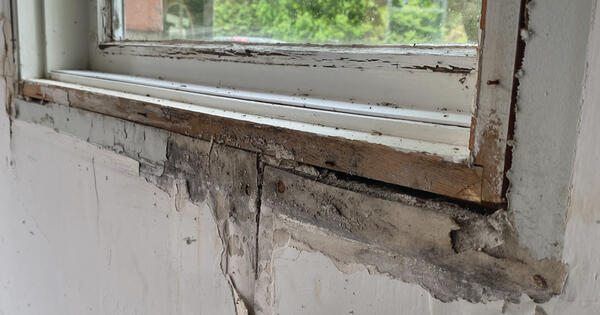
PVC is inherently non-porous. Water rolls off the surface rather than soaking in, which means the panels won't degrade, swell, or support mold and mildew growth regardless of how long they're exposed to moisture. Drywall, by comparison, can begin growing mold within twenty-four to forty-eight hours of water exposure. Even cement board, commonly used as a tile backer, can absorb moisture at the seams over time. If mold is already a concern in your bathroom, see our guide on how to detect and prevent mold growth on your bathroom ceiling.
Trusscore Wall&CeilingBoard panels are 100 percent water and moisture resistant throughout their entire service life, making them suitable not just for residential bathrooms but also for commercial environments like locker rooms, wash bays, and healthcare facilities where hygiene standards are strict and surfaces need to be pressure-washed regularly.
Faster and Easier Installation
PVC panels install significantly faster than tile or drywall. Trusscore Wall&CeilingBoard, for example, installs up to four times faster than drywall and twice as fast as fiberglass reinforced plastic (FRP). There's no taping, no mudding, no sanding, and no waiting for grout to cure. Panels go directly onto studs or over existing surfaces, and the interlocking tongue-and-groove system hides fasteners as you work.
The panels are also lightweight, weighing about forty percent less than drywall. That matters when you're working overhead on a bathroom ceiling or maneuvering panels in a tight shower enclosure. One person can handle the installation without a second set of hands for most of the work.
Low Maintenance
Once PVC panels are installed, they require almost no upkeep. There's no grout to regrout, no paint to touch up, and no surface to seal. Cleaning is as simple as wiping down with soap and water or, for commercial applications, pressure washing. Trusscore panels can withstand chemical cleaners and disinfectants without surface degradation, which makes them well-suited for bathrooms that see heavy use.
The panels also maintain their bright white appearance over time. Unlike painted drywall that yellows, fades, or shows water stains, the factory finish on Trusscore panels holds its color without repainting or refinishing.
Cost Savings
PVC panels have a higher upfront material cost than drywall, but the total cost of ownership tells a different story. When you account for the labor savings during installation, the elimination of finishing steps (taping, mudding, painting, grouting), and the dramatically reduced maintenance costs over the life of the product, PVC panels consistently come out ahead.
Trusscore Wall&CeilingBoard delivers fifty-five percent lower total cost of ownership compared to drywall when installation, maintenance, and longevity are factored in. For a renovation where you're hiring labor, that difference is significant. Use the Trusscore Cost & Materials Estimator to get a ballpark figure for your specific project before committing to materials.
Design Versatility
Modern PVC bathroom wall panels aren't a one-look option. Trusscore Wall&CeilingBoard is available in white and gray, both in a clean, semi-gloss finish. Panels can be installed vertically or horizontally, or mixed for visual interest. The bright white panels have a light reflectivity value of 0.90, meaning they reflect ninety percent of the light that hits them. In a smaller bathroom, that reflectivity can make the space feel noticeably larger and brighter without adding fixtures.
Where Can You Use PVC Panels in a Bathroom?
PVC bathroom wall panelling is versatile enough for nearly every area of a bathroom, from the shower enclosure to the full perimeter walls and ceiling. Here's where it works best.


Shower Walls and Wet Zones
Shower walls are arguably the most demanding surface in any bathroom. They're exposed to direct water spray, steam, temperature swings, and cleaning chemicals on a daily basis. PVC shower wall panels, sometimes sold as plastic shower wall panels, are built for exactly this environment. Trusscore Wall&CeilingBoard can be installed as a fully waterproof shower surround when combined with a cement board backer and a liquid waterproofing membrane. For a closer look at skipping tile in the shower altogether, see waterproofing bathroom walls without tile.
For shower installations, vertical panel orientation is recommended for best drainage. Silicone sealant is applied along panel seams and corners to create a watertight barrier, and J trim pieces at the perimeter complete the enclosure. The result is a clean, grout-free shower wall that you can hose down without worrying about what's happening behind the panels.
Full Bathroom Walls and Ceilings
PVC wall paneling works just as well outside the shower zone. Covering the full perimeter of a bathroom with PVC panels eliminates the vulnerability of drywall in high-humidity environments. Bathroom ceilings are especially prone to moisture damage and mold, particularly in spaces with poor ventilation. A PVC ceiling panel system solves that problem completely.
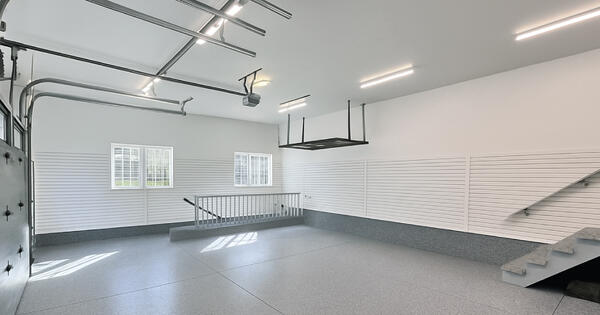
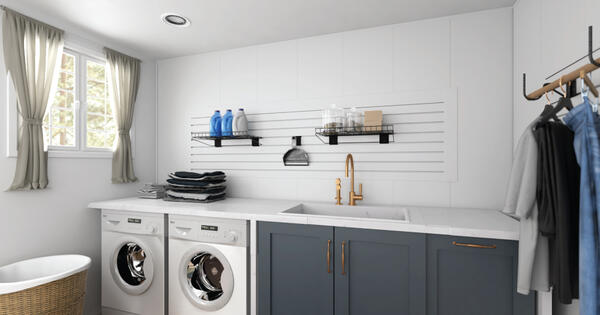
For homeowners looking to add both wall coverage and storage, Trusscore SlatWall integrates seamlessly with Trusscore Wall&CeilingBoard, creating a unified system that covers walls and adds functional, reconfigurable storage in the same space. It's particularly useful in smaller bathrooms where wall space doubles as storage.
High-Humidity Considerations
North American climates vary significantly, and that matters for bathroom renovations. In humid regions like the Gulf Coast or the Pacific Northwest, bathrooms without proper ventilation can maintain elevated humidity year-round, which accelerates the degradation of conventional materials. In colder climates, temperature swings between a hot shower and a cold ambient environment create condensation that accumulates behind walls.
PVC panels handle both extremes well. The non-porous surface doesn't absorb moisture, and the interlocking panel system creates a barrier that keeps moisture from working its way behind the wall assembly. For installations in particularly wet environments, Trusscore recommends drilling drainage holes in the bottom J trim and applying silicone at all seams for maximum protection.
How to Install PVC Bathroom Wall Panels
Installing PVC bathroom wall panels is a manageable DIY project for most homeowners with basic carpentry skills. The process is straightforward compared to tile, and the interlocking panel system makes alignment easier than you might expect. Here's what the installation process looks like from start to finish. For full step-by-step instructions, visit Trusscore's installation resources.
Surface Prep
Before any panels go up, the surface needs to be ready. Check that all framing is straight and consistent. Standard stud spacing is sixteen inches on center, and panels should be fastened to every stud. If the surface isn't flat, install furring strips to create a consistent mounting plane.
For shower applications, the process starts with a cement board backer applied over the substrate, followed by a liquid waterproofing membrane. This step protects the wall assembly behind the panels. In non-shower areas, panels can be installed directly over bare studs or over existing drywall. Vapor barriers should be in place before panels go up wherever local building code requires them.
Panels should acclimatize in the installation space for at least twenty-four hours before being installed, particularly if there's a significant temperature difference between storage and the room. This minimizes expansion and contraction after fastening.
Adhesive vs. Mechanical Fastening
Trusscore Wall&CeilingBoard uses mechanical fastening rather than adhesive. Screws go through the pre-punched screw flange into the stud, and the tongue-and-groove system hides the fasteners beneath subsequent panels. This approach is cleaner and more reliable than adhesive-based systems, and it allows individual panels to be removed and replaced if needed.
The recommended fasteners are corrosion-resistant #8 or #10 gauge screws with a low-profile head (truss head, pancake head, or similar). For standard wood stud installations, 1 1/4-inch screws work well. When installing over existing drywall, 1 3/4-inch to 2-inch screws are recommended to reach the stud behind. Screws should be snug but not overtightened. Panels need to slide slightly on the fastener to accommodate expansion and contraction.
Sealing Joints and Corners
In wet areas like showers, silicone sealant at the panel seams and corners is critical. Apply a thin bead of silicone along the tongue of each panel before interlocking it with the adjacent panel. At corners, trim pieces provide structural support, but a bead of silicone along the front-facing edge of trim pieces adds a watertight seal. Any kitchen and bath silicone sealant works for this application.
In non-shower bathroom areas where moisture exposure is less direct, sealant at seams is still a good practice but not strictly required for water resistance. The interlocking panel system provides solid protection on its own.
Can You Install Over Existing Tile?
Installing PVC panels over existing tile is generally not recommended. The better approach is to remove the existing tile. In showers, you can install cement board and a waterproofing membrane and then apply PVC panels over a fresh substrate. This ensures the waterproofing system is intact and the panels have a solid, even surface to attach to.
PVC Panels vs. Tiles: Side-by-Side Comparison
Choosing between PVC wall panels and tile for a bathroom renovation comes down to priorities: budget, timeline, long-term maintenance, and desired appearance. Here's a straightforward look at how the two materials stack up.
Cost (Material + Labor)
Tile materials range broadly depending on the product selected, but mid-range ceramic or porcelain tile typically costs $2 to $8 per square foot. Labor for professional tile installation adds another $5 to $15 per square foot, depending on the complexity of the layout and local market rates. Add grout, adhesive, backer board, and sealer, and the total installed cost climbs quickly.
Trusscore Wall&CeilingBoard typically ranges from $2.75 to $3.75 per square foot in materials, with significantly lower labor costs due to the faster installation process. Panels install up to four times faster than drywall and require no finishing steps, which translates directly into lower labor invoices for hired work and less time for DIY projects.
Durability and Scratch Resistance
Ceramic and porcelain tile are hard surfaces that resist scratches well, but they chip and crack under impact. Once a tile is damaged, the repair typically means removing the affected tile and resetting it, which can disturb adjacent grout and create a visible patch. PVC panels are scratch, dent, and impact resistant. They flex slightly on impact rather than cracking, making them more forgiving in high-traffic or utility applications.
Long-Term Maintenance
Tile's grout lines are its biggest long-term liability. Grout is porous, and in a shower environment it needs regular sealing to resist moisture penetration. Even with sealing, grout discolors, cracks, and eventually needs to be replaced. PVC panels have no grout, which eliminates that entire maintenance category. Cleaning is soap and water, and the surface looks the same in year twenty as it did on day one.
| Feature | PVC Panels (Trusscore) | Ceramic / Porcelain Tile | Drywall |
|---|---|---|---|
| Water Resistance | 100% waterproof | Resistant (grout is not) | Very low |
| Mold / Mildew | Will never grow | Risk at grout lines | High risk if wet |
| Installation Speed | 4x faster than drywall | Multi-day process | Baseline |
| Maintenance | Very low | Moderate (grout upkeep) | High (painting, repairs) |
| Material Cost | $2.75 to $3.75/sq ft | $2 to $8/sq ft | $0.50 to $1.50/sq ft |
| Labor Cost | Low | High ($5 to $15/sq ft) | Moderate |
| Long-Term Durability | Excellent | Good (tiles crack) | Poor in wet areas |
| Scratch Resistance | High | High (chips on impact) | Low |
| Cleanability | Pressure washable | Grout requires scrubbing | Must avoid excess water |
FAQS
Here are answers to the questions homeowners and contractors ask most frequently about PVC bathroom wall panels.
Are PVC bathroom wall panels waterproof?
Yes. PVC bathroom wall panels are 100 percent waterproof. PVC is a non-porous material, meaning water can't penetrate the surface. When panels are installed with silicone sealant at the seams and corners, the entire system creates a watertight barrier that resists moisture throughout the panel's service life, making it suitable for showers, wet zones, and high-humidity environments.
How long do PVC bathroom panels last?
High-quality PVC panels are engineered for exceptional longevity. Trusscore Wall&CeilingBoard has a rated service life of up to one hundred years and is backed by a twenty-year standard warranty with a lifetime extended warranty when registered within ninety days of purchase. Because PVC doesn't degrade, warp, or support mold growth, the panels maintain their appearance and performance for decades without refinishing or replacement.
Can you tile over PVC wall panels in a bathroom?
Tiling over PVC wall panels is not recommended. PVC is a smooth, non-porous surface that standard tile adhesive doesn't bond to reliably. Tiles applied over PVC are prone to failing over time. If you're planning a tile installation, it should go over an appropriate substrate like cement board. If you already have PVC panels installed and want tile instead, the panels would need to be removed and the substrate properly prepared before tiling.
How do I install PVC bathroom wall panels?
The basic installation process involves preparing the substrate (checking framing, adding vapor barriers or waterproofing as needed), installing perimeter trim, cutting panels to length, and fastening them using the interlocking tongue-and-groove system. Trusscore Wall&CeilingBoard uses mechanical fasteners driven through a pre-punched screw flange into studs, with each new panel's tongue clicking into the previous panel's groove to hide the fastener. See Trusscore's full installation guides for detailed step-by-step instructions for vertical, horizontal, and shower installations.
Are PVC wall panels cheaper than tiles?
PVC panels can be competitive with mid-range tile on material cost alone, and they're significantly less expensive when labor is included. Tile installation requires skilled labor for setting, grouting, and finishing, which adds $5 to $15 per square foot to the project cost. PVC panels install much faster and require no finishing steps, making the total installed cost lower in most cases. Over the life of the installation, PVC panels also require less maintenance than tile, reducing long-term costs further.
Are PVC wall panels safe for showers?
Yes. PVC panels are safe and well-suited for shower installations. They're non-toxic, low-VOC compliant, and don't off-gas harmful compounds. Trusscore Wall&CeilingBoard meets the California Department of Public Health (CDPH) 01350 standard for low-emitting materials and provides complete protection against bacteria, fungi, and viruses (ISO 846:2019). For shower installations, the panels are installed over a waterproof membrane on cement board backer, with silicone-sealed seams for a fully watertight result.
PVC bathroom wall panels are a practical, durable, and increasingly cost-effective alternative to tile for both residential and commercial bathrooms. They're waterproof by design, install faster than any competing material, require almost no maintenance, and perform reliably for decades without repainting, regrouting, or replacement.
If you're renovating a bathroom, finishing a shower surround, or dealing with chronic moisture problems on existing walls, PVC panels are worth serious consideration. For utility applications, locker rooms, or commercial wash facilities, they're often the best material available.